
Is your work style written in the stars?


Product Research Intern Jacky Huang and Software Engineer Willy Wu discuss the resurgent interest in astrology and how they’re putting it into practice at work with their new collaborative FigJam widget, FigStrology.
Share Is your work style written in the stars?






If you’ve noticed your skills getting sharper and the path to collaborative work getting smoother, that may be because Mercury, ruler of communication and intellectual pursuits, just entered Virgo, the sign often described as detail-oriented and practical. Welcome news for this Virgo, who is hustling to hit a deadline and coordinate a launch with a group of coworkers.
While astrology has been around for over 4,000 years, it has largely been an individual experience, with people seeking private counsel on the right and wrong times to find love and purpose on the cosmic clock. More recently, there has been a surge in interest in the astrological collective. 29% of Americans believe in astrology (a greater percentage than Americans using Snapchat in 2022). Millions of them use the CHANI app or Co–Star.

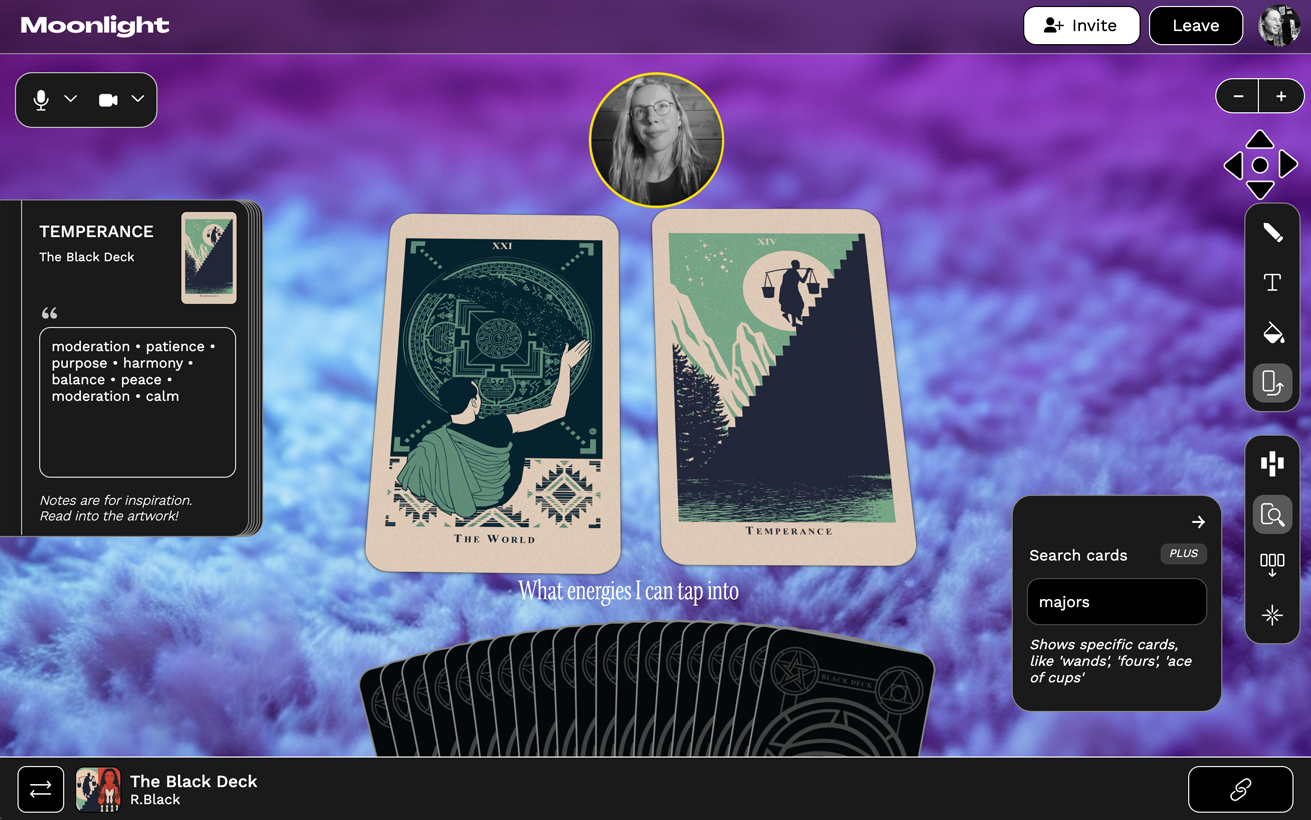
Product Designer Danielle Baskin designed Moonlight in Figma as a space for social tarot.
Figma’s community is building on this trend, melding divination tools with collaborative work. Product Designer and Visual Artist Danielle Baskin used Figma to build her app Moonlight, which offers a place for people to participate in tarot as a new social ritual, positioning the centuries-old art as a tool for reflection. Figma launched a persona quiz at the end of 2022 that over 26,000 people have taken; and most recently, Figma Software Developer Willy Wu and Product Research Intern Jacky Huang built FigStrology, a widget that uses machine learning to deliver a unique astrological persona and horoscope based on stickies and the current “cosmic conditions” of your FigJam files. We spoke with Jacky and Willy about what inspired this widget and how astrology might bring us closer and enhance collaboration at work.

How did you get into astrology, and what do you think makes it appealing to so many people?
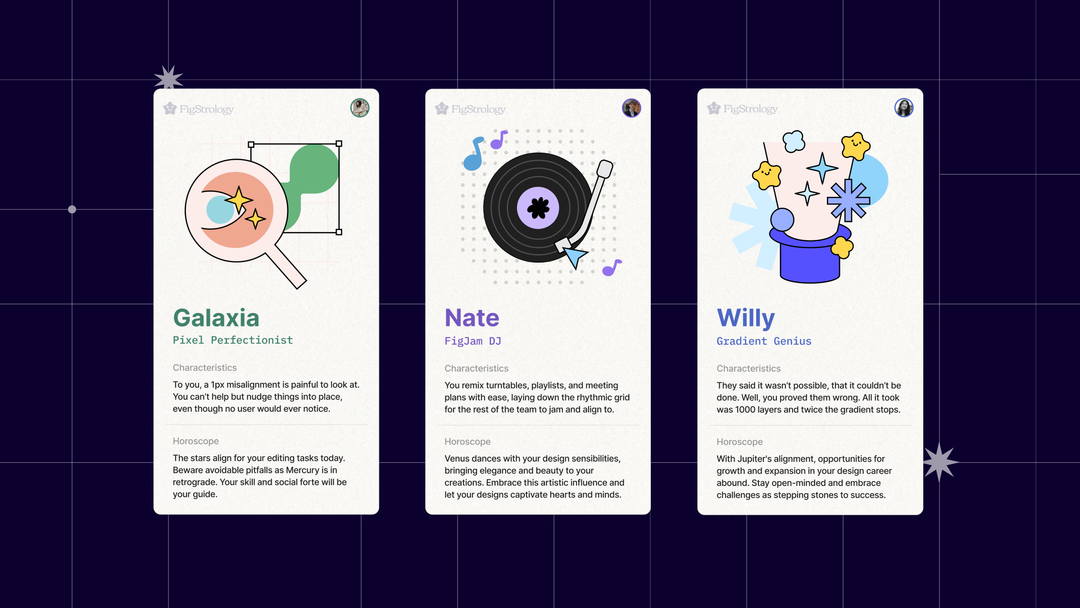
Anita Sirene’s most popular pick a card video has over 846,000 views.
If I had to point to a time, I would say COVID was when I really got into astrology and tarot. I somehow landed on tarot card readings on YouTube—where you pick a tarot deck, and a tarot card reader will tell you what is going to happen for all of the people who picked the cards in a pile. It was often so accurate. I was hooked watching these every single month; I would wait for them.
Horoscopes are like having someone tell you something about yourself that you might not fully recognize or realize in the moment.At the end of the day, we all want to be recognized, heard, and be seen and understood by others—even strangers. What’s fun is you can take it or leave it. It either resonates, or it doesn’t. It can be something you take really seriously, or it can be something fun like an astrology horoscope persona widget on FigJam.
At the end of the day, we all want to be recognized, heard, and seen and understood by others—even strangers.
For me, in this world of uncertainty—and just generally what it’s like to be young and faced with the unknown—it helps to know that I’m not alone. There are other Pisces out there. There are other Leos out there. To feel a sense of belonging, to feel a sense of connection. On some primitive level, it’s just kind of nice to see a horoscope—it’s like a piece of advice from a wise sage. It feels magical, like a piece of guidance, even though it’s humorous and you might not trust it. When it resonates, you’re like, “Yeah, this really vibes with me.”
What sparked the idea for the FigStrology widget?
Well, my favorite FigJam widget is the Photo Booth widget, and I was like, “Wow, I wonder if there’s a way we can connect this idea of behavior and activity in Figma or FigJam with something fun like the Photo Booth.” That’s when it all started clicking: What if we just had a FigJam widget that told you your horoscopes and persona based on everything you did in that file?

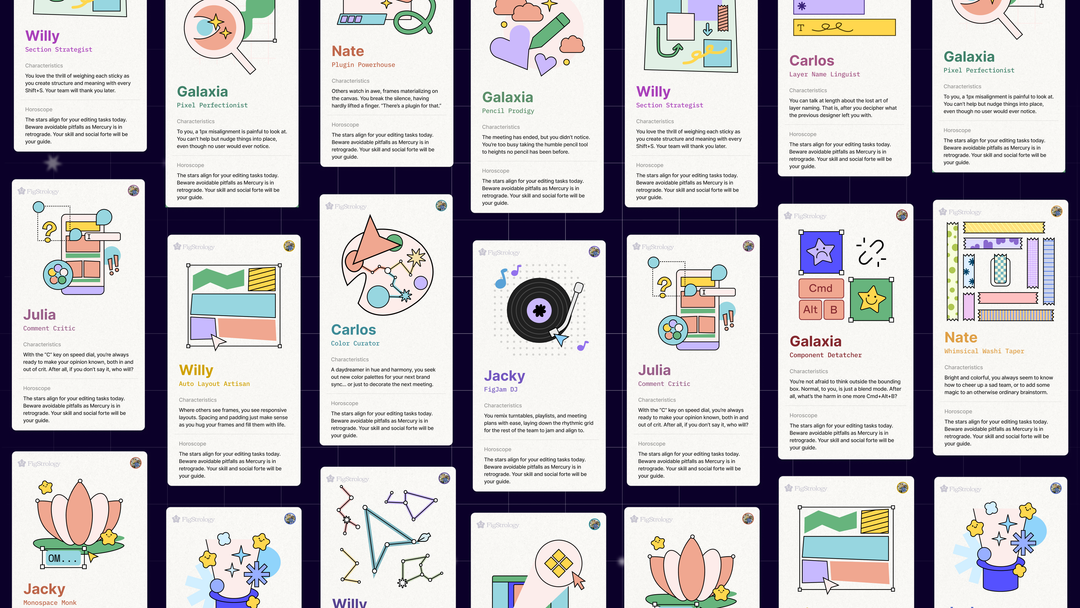
What does the widget take into account for each FigStrology sign?
We wanted to highlight diversity and people. Other people’s strengths can be your weaknesses and by working together, you can achieve something greater than you can alone. It invites you to explore and embrace differences as everyone’s uniqueness. Are you good at thinking in systems? Are you good at thinking in a very unstructured environment? Are you good at being in the spotlight, or do you do your best work behind the scenes? It’s like, where do you do your best work?
Other people’s strengths can be your weaknesses and by working together, you can achieve something greater than you can alone.
There's a fun, tongue-in-cheek tone to the FigStrology cards. How did you inject personality into the project?
Widgets are, by architecture, multiplayer. They’re built to be collaborative from the ground up. FigJam is more than just putting sticky notes down together—it’s a collaborative canvas. It’s this whole ecosystem of collaborative tools. You do your best work when you’re connected with others, when you’re able to have these serendipitous moments, when you can high five. Joy and fun are not a thing you turn on at the end of the workday, like, “Oh, now it’s my personal life. Let me do my fun stuff.” You can have joy throughout the day, and you’re a better person for it.

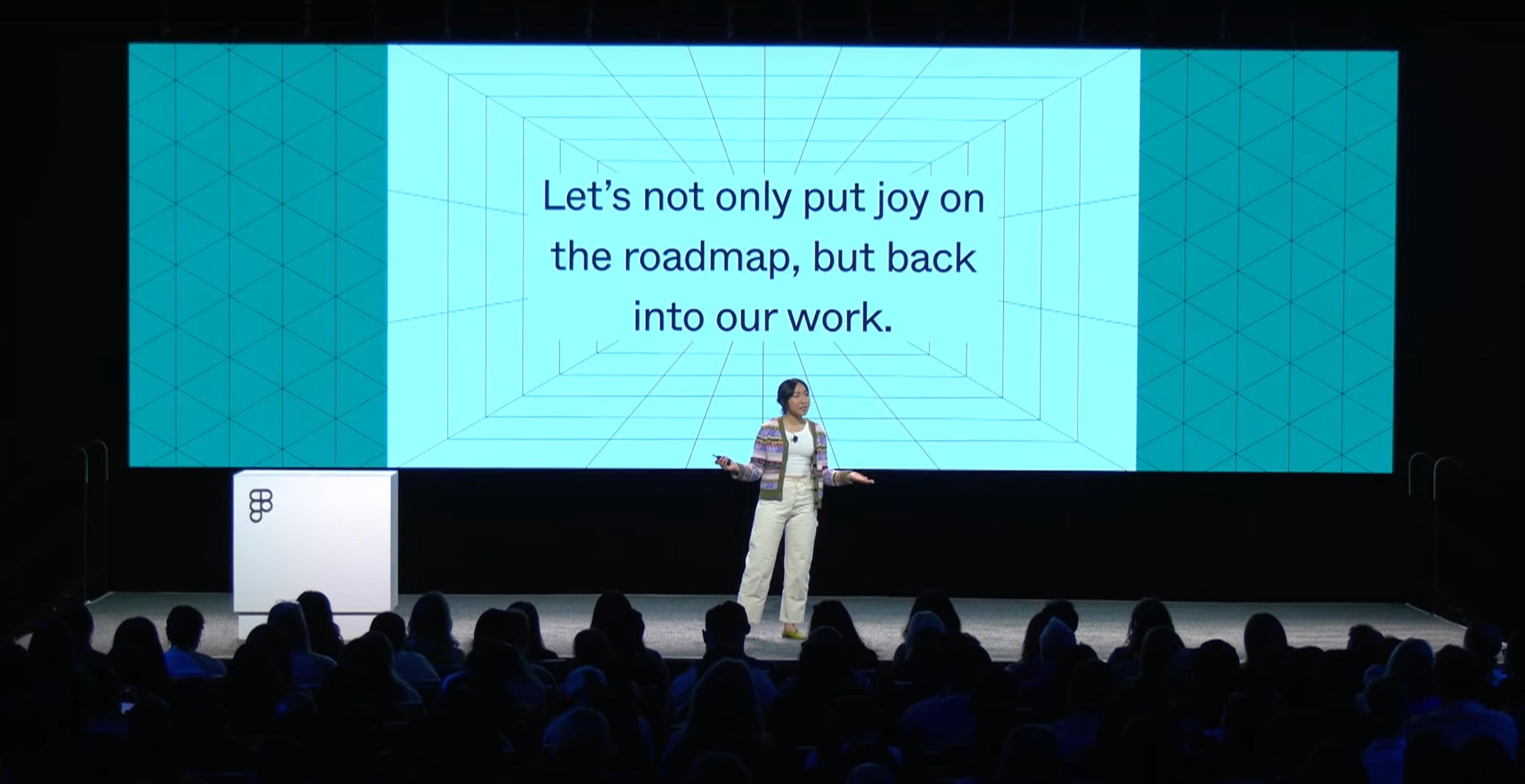
One source of inspiration for the team was a talk from Product Manager Mihika Kapoor, Design Manager Jenny Wen (above), and Product Designer Kee Yen Yeo about the importance of putting joy on the roadmap at Config 2023.
Anyone can make a widget for FigJam and have it be a part of this FigJam mission, pro-fun and pro-productivity. That’s how we were originally able to build this widget, too. A ritual or wind-down activity like FigStrology is just one way to to inject joy—to end your meeting in a way that’s not just like, “Okay, go get your action items done.”
You do your best work when you’re connected with others, when you’re able to have these serendipitous moments, when you can high five.
Willy’s and Jacky’s go-to astrology resources include The Pulp Girls, Astrology Memes, Sanctuary, Anita Sirene, and Tarottok.
Why is it so important to you to bring play into work?
I grew up in a rural suburb in South Carolina, and I immigrated from China. In immigrant culture, there’s such a big focus on work—as a means to survive, to exist, as well as a means in and of itself. This idea of fun and creativity never really existed in my early definitions of work growing up. My parents wanted me to be an economics major, but I ended up as a sociology and East Asian studies major.
My first time using Figma and FigJam were magical, and I wanted to help spark that same magic for others through helping them build amazing products. Which is why I wanted to intern here. Figma’s maker culture is so focused on bringing the creations of people’s wildest imaginations to life; it was probably only here that I’d be able to co-create an astrology FigJam widget and hopefully spark more fun and magic in everyday work. After starting college and completing this internship at Figma, choosing things for myself, choosing these windier paths that don’t seem to make as much sense—the fun paths in life—I’ll continue to look for that in everything now.

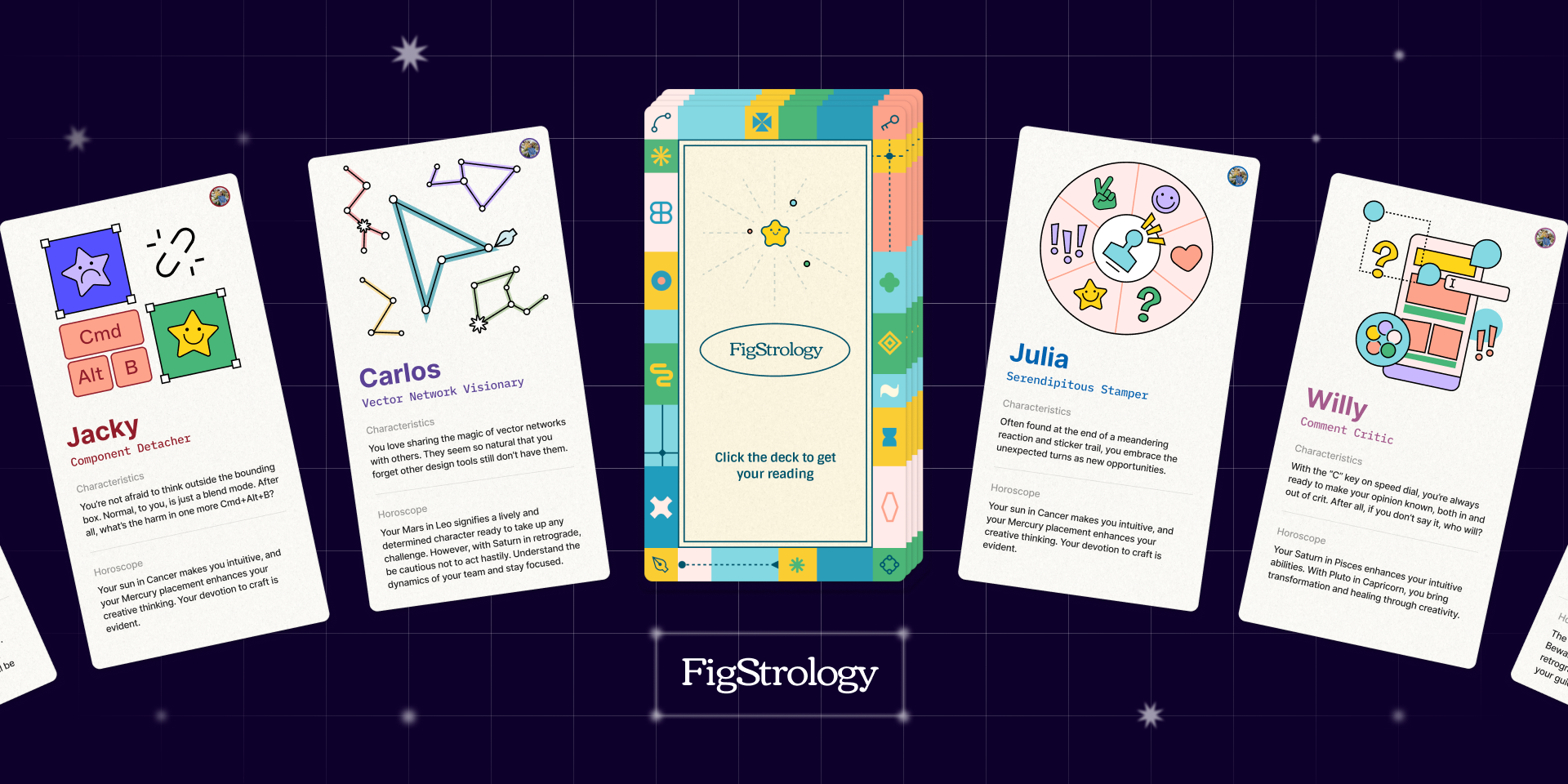
FigStrology was created by Willy Wu, Jacky Huang, Carlos Conley, Julia Han, Galaxia Wu, and Nate Bennett.